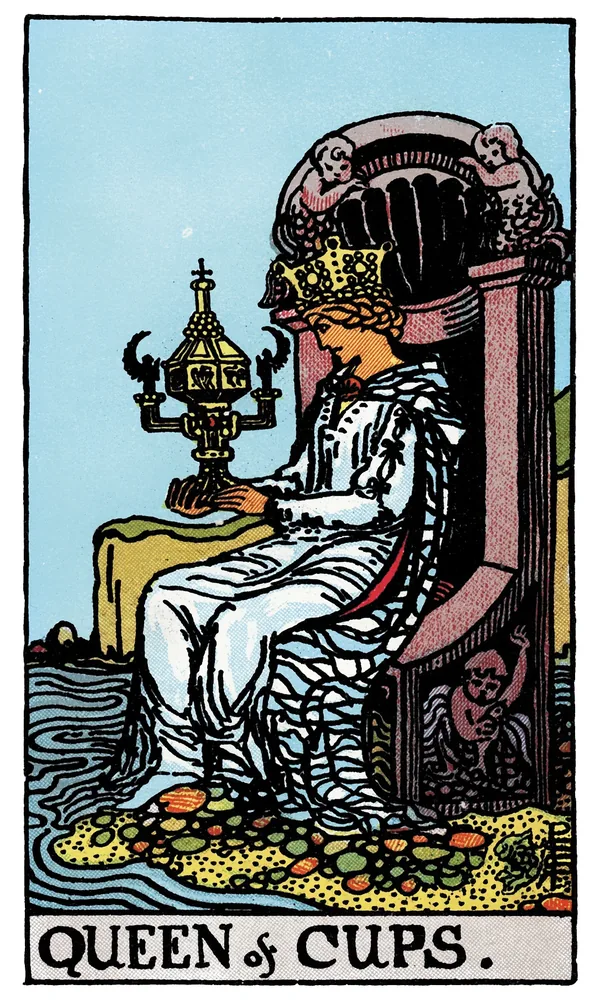
queen of Cups
Queen of Cups
- compassion
- intuition
- care
- reflection
- emotional depth
A crowned woman in a flowing white gown sits on an ornate throne carved with seashell forms, small mermaid-like or cherub figures on top and carved water-creatures below. She holds a highly decorated, lidded golden chalice topped with a cross and flanked by small winged figures, gazing at it quietly. The throne sits at the water's edge on a bed of smooth, colourful pebbles and shells, with gentle waves around and a pale blue sky.
- Element
- Water (court card: Water of Water in many systems)
- Astrology
- Water of Water in many Golden Dawn-based systems, expressing the element in its most receptive and intuitive form.
- Numerology
- Thirteen in the court sequence marks the Queen as the matured, inward-holding stage: emotional intelligence that sustains rather than chases.
Symbols in the picture
- Ornate covered chaliceFeelings treated with reverence: kept, shaped and not carelessly spilled, with the lid showing discretion.
- Throne carved with shells and sea figuresAuthority rooted in emotional depth and in belonging to the waters of the unconscious.
- Water lapping at her feetA close relationship with feeling: she is near enough to be moved by it yet seated safely above it.
- Pebbles and shellsSmall treasures gathered at the shore, representing attention to details of mood and memory.
- White flowing gownClarity and receptivity; an open, uncluttered way of receiving others' emotions.
Meanings
- empathy
- intuition
- nurturing
- emotional maturity
- compassion
In general
The Queen of Cups sits at the edge of the water with her eyes on a closed, jewelled cup, completely absorbed in feeling without being swept away. She represents the capacity to understand what others are going through and to respond with care. People in this energy listen deeply, sense moods and offer a safe place to speak. The lid on the chalice suggests discernment: she knows which feelings to share and which to hold. As an invitation, the card asks you to trust your intuition, nurture your relationships and stay close to your own emotional life. Sensitivity becomes strength when paired with boundaries. Take quiet time to hear what your heart is telling you and give yourself the same kindness you give others.
Love and relationships
Gentle, devoted and emotionally honest love is favoured. You may be called to listen deeply, or to be listened to. Healthy boundaries keep care from turning into self-sacrifice.
Career
Work involving care, counselling, teaching, creative arts or hospitality fits well. Intuition about people and a calm, supportive presence are assets. Team morale may rely on you; protect your own energy as well.
Money
Consider how emotional states influence spending and giving. Generosity can be wonderful when it is balanced with your own needs, and nurturing habits of saving can also be an act of care.
Personal growth
Build emotional literacy and self-care routines that honour sensitivity. Quiet time, creative expression and trusted conversation help you process what you absorb from others.
Spiritual
Intuition, dreams and a feeling for the sacred in ordinary life are highlighted. Meditation near water or contemplative art may feel natural.
A question to reflect on
How can I be as kind to my own feelings as I am to those of the people I love?
- emotional overwhelm
- codependence
- moodiness
- self-neglect
In general
Reversed, the water rises. The Queen's sensitivity may become overwhelm: absorbing everyone's feelings, losing track of what is yours, and ending exhausted or resentful. The covered cup may be sealed too tightly, leading to emotional withdrawal and mood shifts that others cannot read. In relationships, empathy can slide into codependence or a need to rescue, and in some cases into using emotion to influence others. Another pattern is neglect of your own needs while caring for everyone else. The invitation is to rebuild a shoreline: boundaries, rest, honest speech about what you cannot carry, and support that gives something back to you. Care that includes yourself is care that lasts.
Love and relationships
Over-giving, emotional dependence or mood swings might strain a relationship. Clear boundaries and honest communication about needs help. Avoid expecting others to guess how you feel.
Career
Taking on others' stress or burning out in caring roles is a risk. Delegate, set limits and make time for recovery. Trust your intuition, but check it against facts.
Money
Giving beyond what is comfortable, or spending to soothe feelings, could be a pattern. Look at how care for others and care for yourself are balanced in your resources.
Personal growth
Practise separating your feelings from other people's. Rest, solitude and a support network can help you regain steadiness without shutting down.
Obstacles
The inner conflict is between compassion and self-preservation: caring deeply feels like duty, so saying no registers as betrayal, and the heart runs dry.
A question to reflect on
Whose feelings am I carrying that are not mine, and what would setting them down look like?
Positive expressions
- Deep empathy and listening
- Trusted intuition
- Emotional steadiness and care
Challenging expressions
- Absorbing others' feelings
- Codependence
- Mood-driven withdrawal
Journaling prompts
- How do I recognise when I am absorbing another person's mood?
- What boundary would help me stay kind without feeling drained?
- What does my intuition say about the situation I keep rationalising?
- How do I like to be cared for, and have I said so?
Themes
- empathy
- intuition
- emotional maturity
- nurturing
- compassion with boundaries
Associations
- Element: Water (court card, Water of Water in many systems)
- Court rank: Queen, the inward, holding stage
- Shells and sea imagery, traditional emblems of the feminine and of Pisces-like depth
- Chalice with a lid: guarded feeling