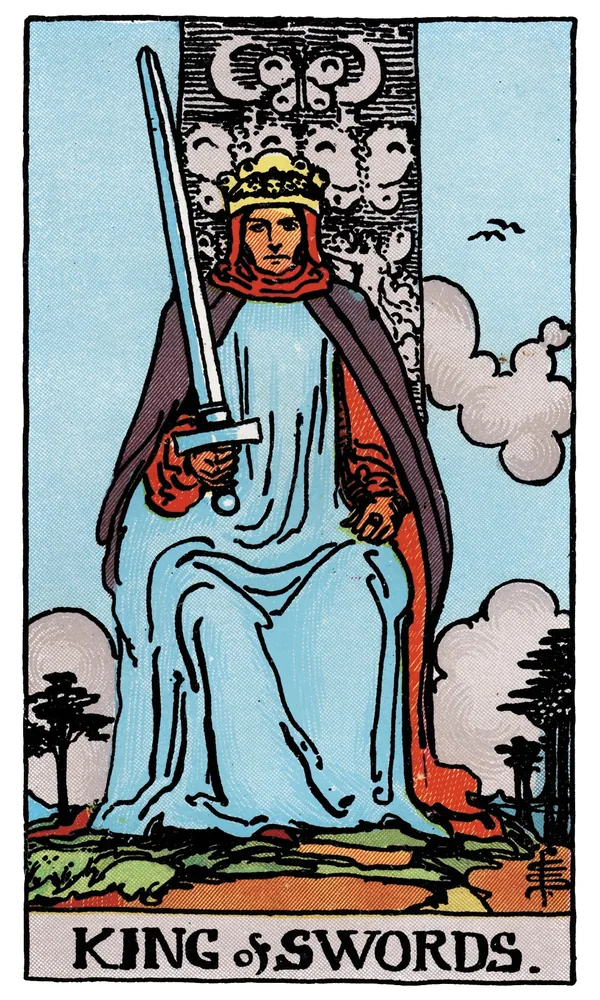
king of Swords
King of Swords
- authority
- logic
- fairness
- strategy
- integrity
A crowned king in a pale blue robe, a deep red under-garment and a purple-grey cloak sits facing forward on a tall stone throne with a dark carved back, decorated with butterfly-like shapes and faces. He holds a long sword upright in his right hand, tilted slightly outward, and rests his left hand on his knee. A red hood frames his face beneath a golden crown. The sky behind is pale blue with soft clouds, a couple of birds are in the upper right, and evergreen trees stand on a green and orange hill at the lower edges.
- Element
- Air
- Astrology
- Air of Air in many systems (the King carries Air at its purest within Air)
- Numerology
- Fourteen here is the King's place in the court: full mastery, in which the power of the mind is fully embodied and carries responsibility for others.
Symbols in the picture
- Upright swordPrinciples held steadily; authority of the mind that decides on facts and consistent values.
- Frontal, steady gazeDirect, impartial attention; the king looks at the matter squarely and is not easily swayed by pressure.
- Crown over red hoodResponsibility joined to a warm heart: leadership that carries concern as well as command.
- Butterflies on the throneChange and the light flight of ideas, now structured within a seat of stable judgement.
- Birds and evergreen treesFree-ranging thought alongside enduring ground, a mind that can fly without losing its roots.
Meanings
- clear judgement
- principled leadership
- expert advice
- ethical standards
In general
The King of Swords is mastery of the mind. As a personality style, he is analytical, fair-minded, articulate and committed to principle, a person who can see all sides, name the issue and decide without being swept away by mood. He stands for rule, expertise and the careful use of words in places like law, teaching, editing, medicine or management, though the card is a style, not a job. His risk is excessive detachment, valuing logic so highly that feelings are overlooked. When he appears, think strategically and communicate precisely, set standards that you are willing to follow yourself, and consider seeking or offering informed, impartial counsel.
Love and relationships
Fair, honest communication and clear agreements build trust. Make sure reason is joined by warmth, and that being right does not replace being close. Say what you value and live by it.
Career
A strong time for leadership, planning, analysis, negotiation, teaching and decision-making according to clear standards. Seek or offer expert counsel. Take care that high standards are communicated with respect.
Money
Think through your resources with strategy and integrity: clear plans, informed advice and decisions consistent with your values. Review agreements carefully before committing, and keep records straight.
Personal growth
Develop an inner authority based on honest thinking and ethical commitment. Pair intellect with empathy, since the best judgement includes how people feel as well as what they say.
Spiritual
Truthfulness and ethical discipline are the path: study, clear reasoning and living by principle. Let wisdom be tested in daily choices, not only in thought.
A question to reflect on
What principle do I want to lead from, and does my way of acting match it?
- rigid control
- cold logic
- misused authority
- manipulative words
In general
Reversed, the King of Swords warns of intellect cut loose from conscience. Authority may become harsh, rules may be applied without compassion, and clever arguments may be used to dominate or mislead. It can also describe a lack of confidence in your own judgement, where you defer to others, avoid decisions or feel your voice is not heard. Another reading is stubbornness: a refusal to revise a position once taken. The path through is to return to principle and humanity together: question your own motives, listen without preparing a rebuttal, and let fairness include kindness. Leadership grows strong when it can admit error.
Love and relationships
Cool detachment, criticism or a need for control may hurt closeness. Notice whether you are arguing to win. Make room for feelings, yours and theirs, to be part of the discussion.
Career
Rigid decision-making, cutting criticism or misuse of authority could create friction. Alternatively, you may doubt your ability to lead. Seek feedback, keep ethics front and centre, and stay open to revising your view.
Money
Avoid rigid or manipulative dealings and consider the human side of decisions about shared resources. If you doubt your judgement, ask an impartial adviser to review the facts with you.
Personal growth
Watch for the use of logic as a shield against vulnerability, and for harsh inner judgement. Practise compassion alongside analysis and be willing to say you were wrong.
Obstacles
The inner conflict is between the need to be correct and in control and the quieter wish to be understood and trusted. Rigidity looks like strength but leaves little room for learning.
A question to reflect on
Where might my certainty be closing a door that curiosity or compassion could open?
Positive expressions
- Principled, fair judgement
- Strategic and articulate thinking
- Reliable, ethical leadership
Challenging expressions
- Emotional detachment
- Rigidity or domination
- Words used to control
Journaling prompts
- What values do I want my decisions to reflect?
- Where have I been so logical that I missed someone's feelings?
- Whose counsel do I trust, and why?
- When was the last time I changed my mind, and what made it possible?
Themes
- Authority
- Intellect
- Fairness
- Strategy
- Integrity
Associations
- Element: Air
- Court rank: King (Air of Air in many systems)
- Suit: Swords
- Role: the judge and strategist