five of Swords
Five of Swords
- conflict
- hollow victory
- competition
- pride
- defeat
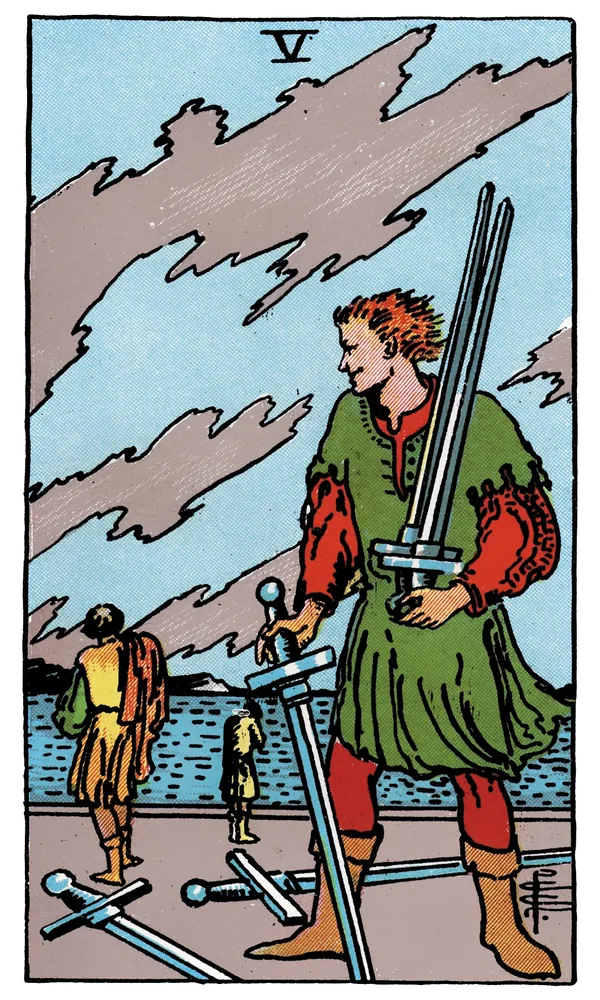
A red-haired young man in a green tunic, red sleeves, red tights and tan boots stands in the foreground with a faint smirk, looking back over his shoulder. He holds two swords upright against his shoulder and rests his other hand on the grip of a third that points down to the ground. Two more swords lie on the stone ground at his feet. Further off, two smaller figures in yellow and orange walk away toward a grey-blue sea with their backs to him. Torn, jagged grey clouds streak a pale blue sky.
- Element
- Air
- Astrology
- Venus in Aquarius (Golden Dawn decan attribution)
- Numerology
- Five is disruption and testing; in Swords it is the point where disagreement turns into a contest, and someone must decide what winning is worth.
Symbols in the picture
- Smirking figure with gathered swordsA win taken at the expense of others. The collected blades show what was claimed, and the glance back asks what it cost.
- Swords scattered on the groundAbandoned weapons and arguments that have been dropped by those who left, a sign of fatigue or defeat rather than agreement.
- Two retreating figuresThose who turn away from conflict, whether by choice or by being worn down; relationships may shift when people walk off.
- Torn cloudsA frayed atmosphere after a quarrel, with the sky shredded by wind, signalling tension that has not yet cleared.
- Sea at the horizonA wider, calmer perspective beyond the fight, available to those willing to look past who won.
Meanings
- win-at-all-costs
- tension
- self-interest
- walking away
In general
The Five of Swords asks what a victory is worth. Someone has gathered the weapons and the point has been won, but the others have left, the ground is littered, and the satisfaction looks thin. The card highlights contests where ego, pride or fear of losing hardens into an all-or-nothing stance, and where truth is used to dominate rather than to understand. It can describe your own conduct or someone else's. Pause to count the real cost in trust, goodwill and energy. Sometimes the strongest move is to let someone else be right, to withdraw from a fight not worth having, or to look for a settlement that leaves relationships intact.
Love and relationships
A disagreement may turn into a contest of who is right, leaving both people lonelier. Consider whether being understood matters more than winning. An apology or compromise may be the braver move.
Career
Workplace rivalry, politics or a tense negotiation may be in play. Pick your battles and notice who is being left behind by an aggressive approach. A fair agreement now can protect future collaboration.
Money
A dispute over shared resources, or a purely competitive attitude toward gain, may come at the expense of relationships. Weigh what is worth defending against what is simply pride.
Personal growth
Examine your relationship with winning, being right and fear of looking weak. You can hold a boundary without humiliating anyone. Practise a calm no instead of a loud victory.
Spiritual
Humility is the lesson: noticing the urge to defend the ego and loosening its hold. Practices of forgiveness and non-harming can transform the competitive impulse into compassion.
A question to reflect on
What am I trying to win here, and what might I lose by winning it this way?
- reconciliation
- lingering resentment
- regret
- ending conflict
In general
Reversed, the Five of Swords moves toward the aftermath. It may indicate that the fighting is subsiding and people are ready to talk, with regret or a wish to repair what was damaged. It can equally show resentment that lingers, a grudge turned inward, or an old argument replayed in the mind long after the others have left. Sometimes it describes having been on the losing side and feeling humiliated, or noticing that you are the one who has been combative. This is a chance to lay weapons down on purpose, to apologise where an apology is due, and to release the need to settle every score in order to move forward.
Love and relationships
Space for repair may be opening after a quarrel, or old resentments may still be getting in the way. A sincere acknowledgement of your part can break the cycle. Avoid bringing up past arguments as ammunition.
Career
Tensions may ease, or you may be dwelling on a defeat or slight. Consider mediation, a fresh start with a rival, or letting a grievance go. Learn the lesson and drop the grudge.
Money
Settlement of a dispute over resources may be possible if both sides soften. If bitterness over a past loss shapes your choices now, notice that and decide what is truly worth pursuing.
Personal growth
Look at shame, regret or the replay of old quarrels. Forgiveness, of others and of yourself, is the work. Owning a mistake without self-punishment is a sign of strength.
Obstacles
The inner conflict is between pride and the longing for peace. A part of you wants to be proven right, while another part would simply like the argument to be over and the relationship restored.
A question to reflect on
Whom do I owe an apology, or what grievance am I ready to put down?
Positive expressions
- Learning to choose battles
- Honesty about ambition and ego
- Opportunity to reconcile
Challenging expressions
- Hollow victories
- Damaged trust
- Pride that hardens into hostility
Journaling prompts
- Describe a time I won an argument and still felt worse. What was missing?
- What do I fear will happen if I let someone else be right?
- Which fights deserve my energy, and which can I leave?
- What would a fair outcome look like for everyone involved?
Themes
- Conflict
- Winning at a price
- Pride
- Defeat
- Choosing battles
Associations
- Element: Air
- Planet: Venus
- Zodiac: Aquarius
- Number: 5